class: center, middle, inverse, title-slide # Data management & IRB ## 710 | Week 3 ### Bradley McDonnell ### 2022/1/24 (updated: 2022-01-24) --- # Preliminaries 1. Sign up for mini-presentation #1 1. Mini-presentations start next week! 1. Reading current to Week 5 (ELAN) ... anyone reading ahead? 1. Keep working on [Archiving for the Future](https://laulima.hawaii.edu/x/hfE5Zo) 1. [IRB](https://laulima.hawaii.edu/x/hfE5Zo) assignment due next week 1. Anything else? --- # Today's class 1. Discuss Data Management 1. Data management small group activity 1. Briefly discuss IRB --- class: center, middle # Linguistics Data Life Cycle ### Mattern (2022) --- # Context / Disclaimer Mattern (2022) deals with *research data* so we need to step back and see how this chapter applies not only to research but also to the many other types of activities non-researchers engage in. --- # Data life cycle models **UK Data Service Model** - Planning research - Collecting data - Processing and analyzing data - Publishing and sharing data - Preserving data - Reusing data --- # Data life cycle US Geological Survey Science Data Lifecycle Model. 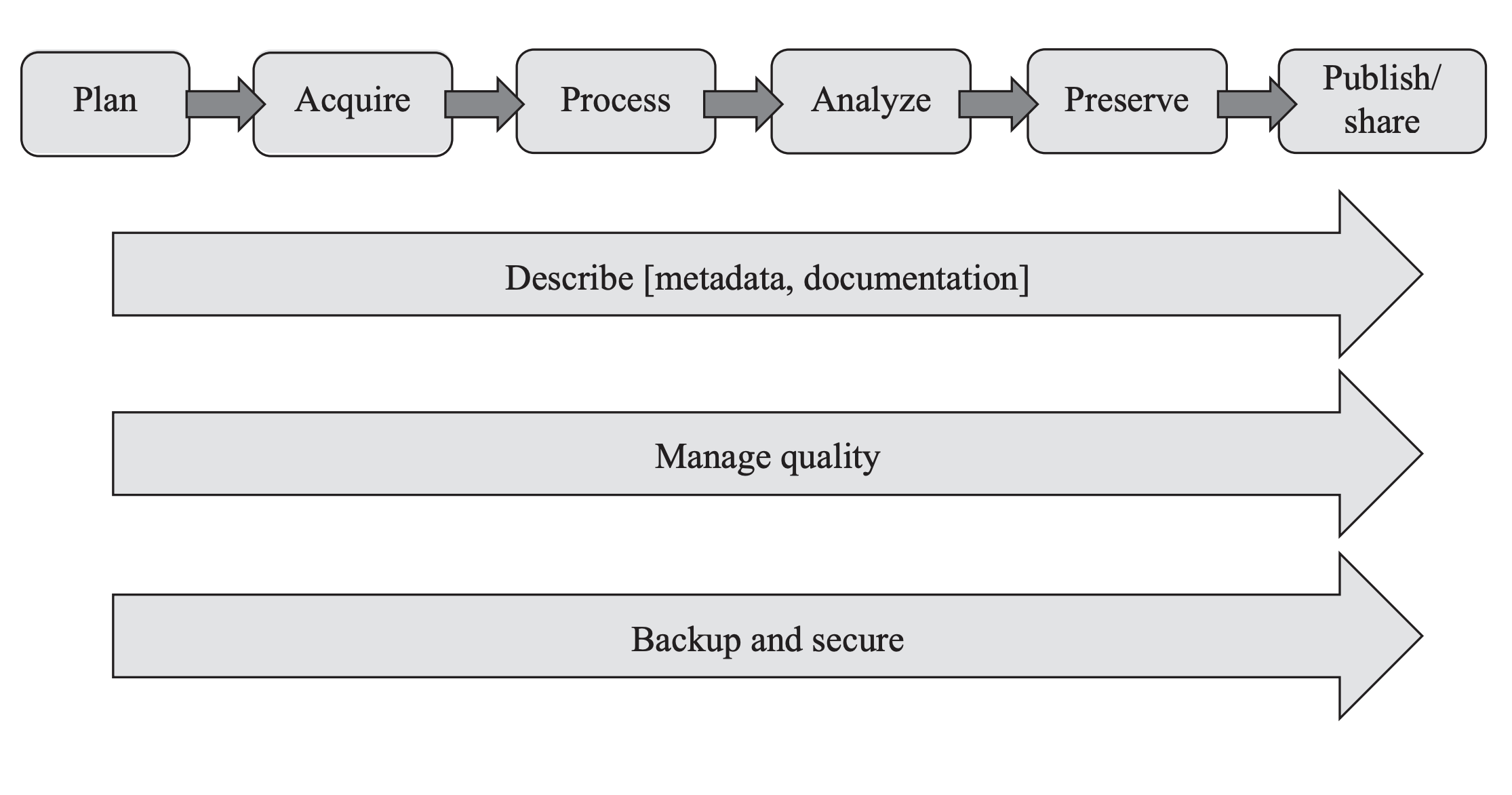 1. How do models from LD and LR differ? ??? Archiving and maybe even sharing go before or simultaneously with analysis. --- # Sustainability of research data 1. Economic sustainability 2. Social sustainability 3. "Technical sustainability" > "disciplinary communities [should] set criteria and methods for selection of research data for long-term preservation." (Berman 2008) - What does LD say about such selection? - Who ensures accountability? --- class: center, middle # Data management practices --- # Planning Plan as much as you can before you begin work. **Unsolicited advice:** Make a document now that outlines how you are going to go about managing data or at least what you need to consider. --- # Sustainable file formats - Some already standard (wav, tiff) - Some not (video file formats) Library of Congress | [Sustainability of Digital Formats](https://www.loc.gov/preservation/digital/formats/index.html]) --- # File naming > There is no one way to name files and good practice is a memorable and sustainable one for the individual researcher and team. (68) **Rules of Thumb** 1. Brevity 2. No spaces or special characters 3. Separating with _, -, or CamelCase ??? Question from Cole: Is there a reason that a general content description is not included in file names usually? --- # Data storage ### 3-2-1 rule - three copies in two different storage media with at least one off-site copy. Note that archives already do this for you, so archiving early and often will help! --- # Metadata > Metadata are information about an object that helps us to understand, find, and use that object. We will discuss in detail next week! --- # Future-minded Perhaps the most important principle to data management is that a future-minded orientation is essential. --- class: center, middle # Data management activity ## Mattern (2022) and Cox (2022) --- # Data management activity 1. Based upon the information your group is provided in the following slides, create a data management workflow. In so doing, answer the following questions: - How will you collect data? - In what forms will it be recorded? - How/when will you process the data? - What software will you use? - How will you manage metadata? - ... ***Provide a practical and specific plan with an appropriate workflow based upon what you learned from Mattern (2022) and Cox (2022).*** I encourage you to fill in the details of this hypothetical situation about the stakeholders and active participants in the projects. --- # Group 1 * **Project:** Documentation and short grammatical description of Qkuan Kambuar * **Language:** Qkuan Kambuar * **Population:** < 10 speakers, all of whom are over the age of 50. * **Location:** Madang, PNG * **Travel:** 2 hour car ride from Madang city, reached via Port Moresby * **Infrastructure:** no electricity, no running water, no indoor spaces, solar panel means laptop can be used 3-4 hours a day. --- # Group 2 * **Project:** Documentation and materials development for burgeoning language program * **Language:** ****** * **Population:** 1,000 speakers * **Location:** Calgary, Alberta * **Travel:** 1 hour by car ride from Calgary * **Infrastructure:** electricity, internet, running water. --- # Group 3 * **Project:** Documentation, description, and sociolinguistic study of language-in-use * **Language:** Besemah * **Population:** 400,000 speakers * **Location:** South Sumatra, Indonesia * **Travel:** 8 hour car ride from Palembang * **Infrastructure:** electricity, running water fairly consistent with outages weekly, 3G internet (paid per MB). --- # Group 4 * **Project:** Documentation and description with a focus mood marking * **Language:** Chini * **Population:** 60 speakers * **Location:** Madang, PNG * **Travel:** > 1 day hike and canoe ride from Madang city, reached via Port Moresby * **Infrastructure:** no electricity, no running water, no indoor spaces, solar panel means laptop can be used 2 hours a day. --- # Group 5 * **Project:** Documentation and development of a pedagogical grammar and dictionary * **Language:** Pohnpeian * **Population:** 34,000 speakers * **Location:** Pohnpei, Federated States of Micronesia * **Travel:** 10.5 hour flight with 4 stops * **Infrastructure:** electricity with frequent outages, intermittent running water, spotty DSL internet/3G internet. --- class: center, middle background-image: url(img/workflow-example.png) background-size: contain --- class: center, middle # IRB ## DiPersio (2014) --- # What is an IRB? <iframe width="560" height="315" src="https://www.youtube.com/embed/d15kYGwYU24?start=7" frameborder="0" allow="accelerometer; autoplay; encrypted-media; gyroscope; picture-in-picture" allowfullscreen></iframe> --- # The Common Rule > The Belmont Report identified three fundamental principles for all human subjects research: respect for persons, beneficence, and justice. > **Respect** for persons means preserving individual autonomy, obtaining participants’ informed consent and being truthful with participants about the study. > The idea of **beneficence** is to do nothing to harm subjects; the goal should be to maximize research benefits and to minimize harm to individuals. > Finally, **justice** refers to procedures that are administered fairly, are reasonable, and are not exploitative. .pull-right[(p. 506, emphasis mine)] ??? Comment from Dannie: I also am fascinated by the relationship between IRBs and sponsors and stakeholders. Linguists seem to be a middle man of sorts, and I wonder if there is a way to create a way for it to be more seamless of a connection. Do you have any ideas? Comment from Juliana about confidentiality and deleting personally identifying material. --- # IRB at UH - The UH Human Studies Program is under the Office of Research Compliance: <https://researchcompliance.hawaii.edu/programs/human-studies/> - Information on submitting a protocol can be found: <https://researchcompliance.hawaii.edu/programs/human-studies/uh-eprotocol/> - Protocols are submitted on **eprotocol**: <https://uhmanoa.keyusa.net/> - CITI info can be found under training: <https://researchcompliance.hawaii.edu/programs/human-studies/hs-training/> --- # Next week 1. Make sure to download and install [lameta](https://github.com/onset/laMETA/releases) *before* class.